
An adult louse measures between two and three millimeters. At this scale, no organ produces sound perceptible to the human ear. The “sound of dead lice” comes up regularly in online searches, but this idea is based on sensory confusion, not on a real acoustic phenomenon.
Origin of the supposed crackling of dead lice
When you crush a louse between your nails or run a fine comb through infested hair, a slight crackling may be heard. This sound is often attributed to the louse itself, whether alive or dead.
In reality, no published acoustic study documents a sound emitted by a dead louse. The perceived sound comes from mechanical friction: the comb’s teeth scraping against the hair, the pressure of the nails, or the resistance of the chitinous exoskeleton at the moment of crushing. A dead louse, motionless and dried out, generates no spontaneous sound.
This confusion perpetuates itself because the context is conducive to hyper-vigilance. A parent inspecting their child’s head strand by strand interprets every micro-sensation as a clue. The brain then associates a mundane friction with the confirmed presence of the parasite. To elaborate on this point, the signs of dead lice on Terre Vivante Et Santé detail why this perception does not constitute a reliable criterion.

Dead louse or living louse: reliable visual criteria on the scalp
Since sound does not allow for distinguishing a dead louse from a living one, one must rely on direct observation. Three criteria allow for an unambiguous decision.
- Mobility: a living louse moves quickly on the scalp, sometimes several centimeters in a few seconds. A dead louse is completely motionless, even when stimulated by the comb.
- Color: alive, the louse is brown-gray, translucent after a blood meal. Dead, it turns dark brown, almost black, and its body visibly dries out.
- Adhesion: a living louse clings to the hair with its claws. A dead louse easily detaches and often falls out on its own during combing.
The same reasoning applies to nits. A living nit is swollen, translucent, and glued near the root. An empty or dead nit appears white, flattened, and is generally located more than a centimeter from the scalp, carried away by hair growth.
Persistent itching after treatment: not always a sign of living lice
The scratching that continues after a lice treatment leads many parents to restart the protocol. This reaction is understandable, but itching alone does not confirm an active infestation.
The saliva of the louse causes a local allergic reaction. This irritation of the scalp can persist for several days after the parasites have died. Scratching worsens the inflammation, which maintains the sensation and doubt.
Only the discovery of a living and mobile louse justifies a new treatment. Careful combing, strand by strand, on wet hair remains the most reliable diagnostic method. The current recommendation, notably relayed by Pharmacie Charnal, is to treat only those individuals in whom a living louse has been found.
Slow movement after application: not a treatment failure
Some lice may still move slowly several hours after the application of a dimethicone-based product. This residual movement does not mean that the treatment has failed. Dimethicone works by suffocation by coating the parasite, and death is not instantaneous.
Multiplying or mixing products out of impatience is counterproductive. Adhering to the instructions, particularly the application time, conditions the actual effectiveness of the treatment.
Second application and verification: the critical point of the anti-lice protocol
Most anti-lice treatments provide for a second application, usually seven to ten days after the first. This interval is not arbitrary: it targets the larvae that may have survived the first treatment.
Skipping this second application is the primary cause of reinfestation. The nits closest to the scalp benefit from body heat and may hatch despite a well-conducted first treatment. The second application eliminates these nymphs before they reach adulthood and lay eggs themselves.
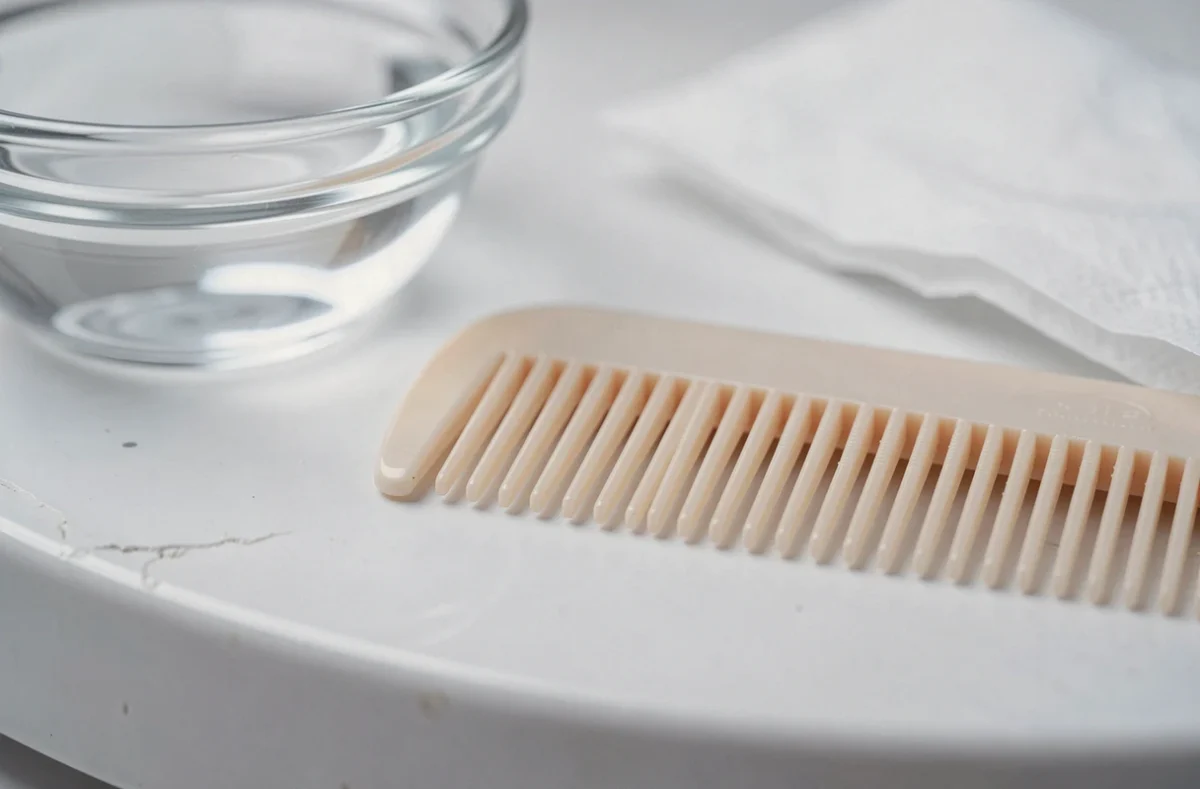
To verify that the infestation is over, a control combing should be performed a few days after the second application. A fine-toothed comb, passed through wet hair, allows for capturing any potential survivors.
- No living lice found during the control combing: the protocol has worked.
- Presence of only dead lice or empty nits: sign of success, no reinfestation.
- Discovery of a mobile louse: a third application or a change of product may be necessary, in consultation with a healthcare professional.
The supposed sound of dead lice remains a reflex of understandable searching, especially when anxiety accompanies each hair inspection. No sound replaces a fine comb and good lighting. The only proof of an active infestation is a moving louse.