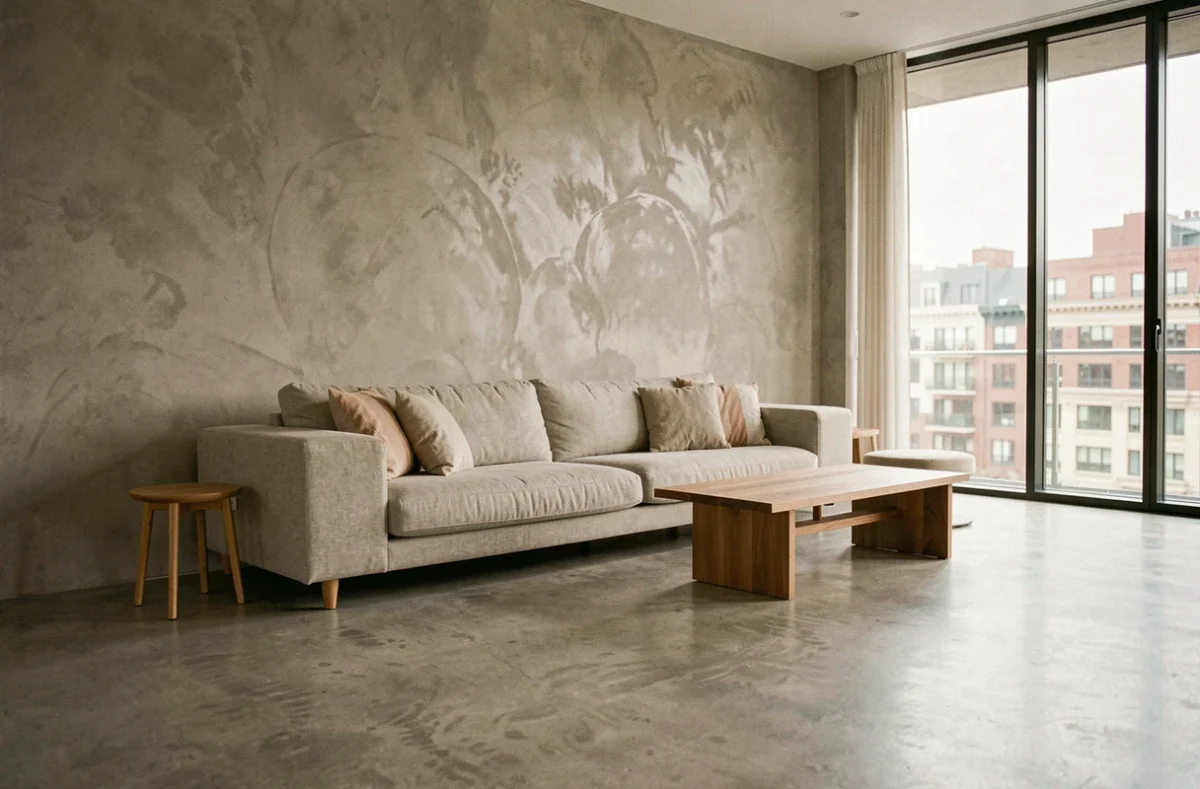
Polished concrete is a decorative coating made from cement, applied in thin layers over an existing substrate. Its final thickness rarely exceeds a few millimeters, which distinguishes it from a poured slab and explains why its behavior directly depends on the surface it rests on. This technical characteristic conditions all subsequent decisions, from the choice of substrate to the frequency of maintenance of the protection.
Preparation of the substrate: the factor that polished concrete does not forgive
Most articles on polished concrete start with colors or the rooms where it can be installed. The real starting point is the substrate. A coating a few millimeters thick does not mask anything: every crack, every movement of the substrate is reproduced on the surface.
Before any application, the diagnosis focuses on four criteria: structural stability, adhesion, flatness, and absence of residual moisture. On old tiles, for example, hollow joints or loose tiles create weak areas that polished concrete will make visible within a few months.
A wooden floor or underfloor heating presents specific expansion constraints. Without appropriate treatment (bonding primer, reinforcement mesh), the coating will eventually crack at the junction points. Specialists like Architop offer systems designed to address these substrate issues, with ranges formulated according to the type of surface to be covered.
The time spent on preparation often represents half of the project. Skipping this step to save a few hours compromises the durability of the coating in the long term.
Polished concrete in wet areas: waterproofing and floor safety
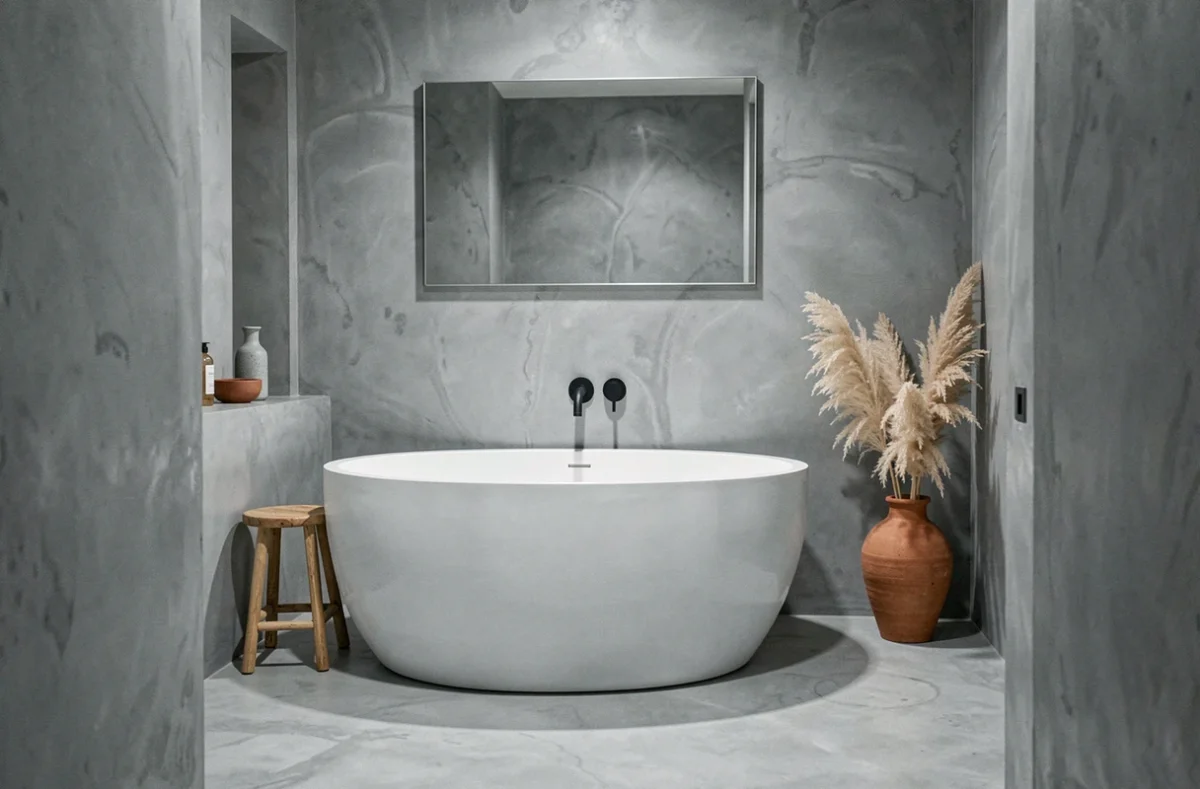
The waterproofing of a bathroom does not rely on the polished concrete itself. The decorative coating is not a waterproofing system. In a walk-in shower or around a bathtub, it is the complete system (waterproof membrane under the substrate, treatment of corners, compatible surface protection) that guarantees the absence of leaks.
A poorly waterproofed substrate or an untreated crack before the application of polished concrete causes moisture to rise. This manifests as dark spots, localized peeling, or, in the most severe cases, degradation of the structure beneath the coating.
Slipperiness: a regulatory constraint to anticipate
In areas that are regularly wet, the issue of slipperiness deserves special attention. A smoothed polished concrete surface protected by a glossy varnish can become slippery when in contact with water. Several solutions exist to remedy this:
- The addition of anti-slip microbeads in the finishing layer, which slightly alters the texture without affecting the visual appearance
- The choice of a satin or matte finish rather than a glossy one, naturally offering more foot grip
- The application of a specific surface treatment for shower areas, distinct from that used on the walls
The choice of finish in the bathroom is therefore as much about safety as it is about aesthetics.
Outdoor polished concrete: UV, frost, and maintenance of protection
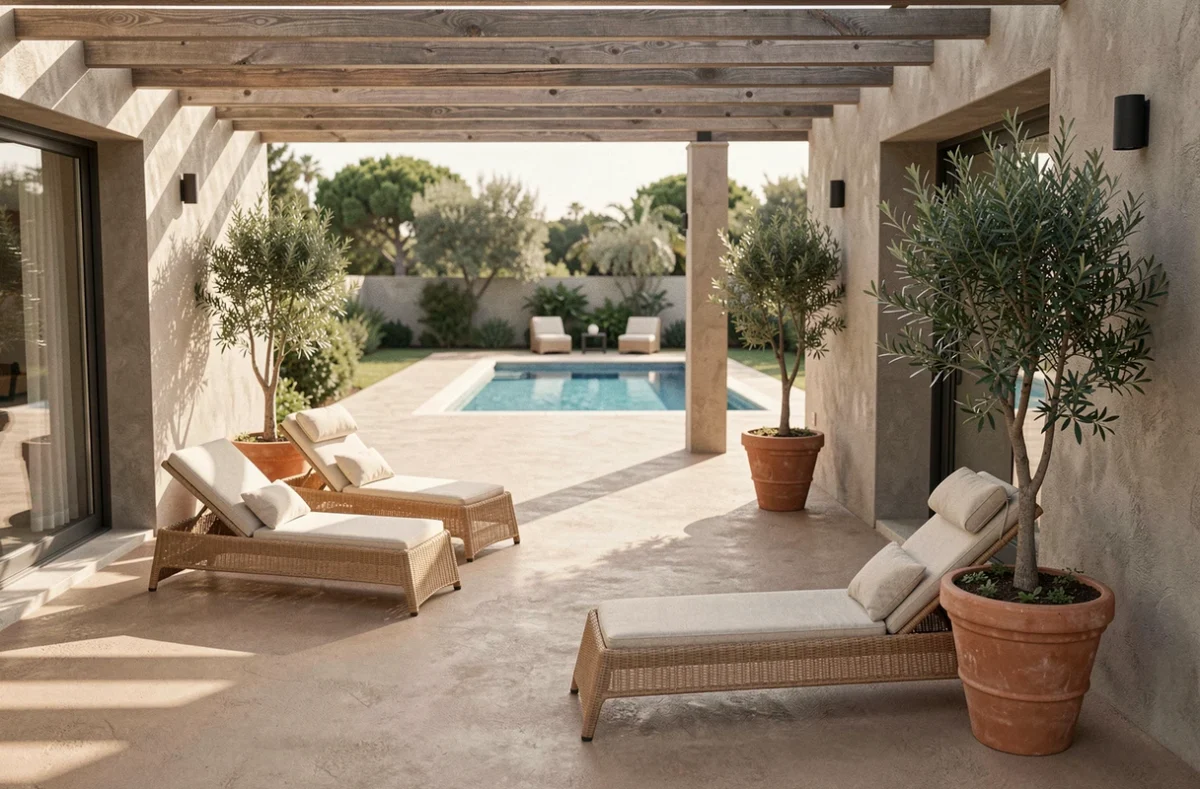
Outside, on a terrace or balcony, polished concrete faces constraints that the interior does not experience. UV rays gradually degrade the protective layer and can change the color if the finishing product is not formulated for sun exposure.
Freeze-thaw cycles represent another factor of wear. Water that seeps into the micro-porosities of the coating expands when frozen, causing chipping or peeling. An outdoor surface protection (polyurethane resin or specific varnish) limits this phenomenon, provided it is renewed regularly.
Surface protection is not a definitive finish but an element of periodic maintenance. Depending on the exposure (full south, shaded area, oceanic or continental climate), the frequency of renewal varies. Neglecting this maintenance transforms an elegant outdoor floor into a porous and stained surface within a few seasons.
Colors and mineral effects: what changes in interior decoration
The palette of polished concrete has significantly expanded. Neutral shades (light gray, beige, off-white) remain the most requested for their ability to visually enlarge a space and to pair well with wood or metal.
More pronounced colors are gaining ground. Gray-blue, sage green, or terracotta allow for the creation of distinct atmospheres while maintaining the characteristic mineral effect of the material. Pigmentation occurs throughout the mass: the color is not a superficial layer but an integral part of the mix.
Polished concrete effect without polished concrete: alternatives
The success of the mineral look has led to derivative products that imitate the appearance of polished concrete without sharing its composition:
- Large-format polished concrete effect tiles replicate the texture and color with the advantage of nearly invisible joints and simplified maintenance
- Mineral effect paints, applicable with a roller, offer a similar visual result for a significantly lower budget, but without the tactile depth of real polished concrete
- Repositionable decorative adhesives for bathrooms provide a temporary solution to test the style before making a more significant investment
The choice between real polished concrete and imitation depends on the budget, desired durability, and the room in question. A high-traffic living room floor justifies real polished concrete. An accent wall in a bedroom can suffice with an effect paint.
Polished concrete remains a coating whose success is determined before coloring, in the diagnosis of the substrate and the sizing of the protection system. Decor trends guide the choice of colors and finishes, but the longevity of the result depends on technical decisions made well in advance.