Eco-construction relies on a rapidly evolving regulatory framework. The RE2020, which came into effect for new housing, requires a life cycle analysis of buildings and sets carbon emission thresholds from the design phase. Since March 2026, decree no. 2026-200 has introduced initial adjustments, and the scope of the regulation now extends to certain tertiary, industrial, and artisanal buildings.
Building sustainably is no longer a matter of choice; it is a technical constraint whose parameters change depending on the date of the building permit application.
RE2020 and eco-construction: a regulatory framework in motion
Most guides on eco-construction present RE2020 as a fixed block. In practice, the regulation undergoes regular adjustments that alter design decisions. The Cerema guide, updated in September 2026, notes developments concerning particularly the extensions and the widening of the scope to tertiary buildings.
For a project owner, this means that an eco-construction project designed based on a document from a few months ago may rely on outdated assumptions. The applicable regulatory version depends on the date of the permit application, not on the date of signing the contract with the architect. The resources available on ecoconstruction.net allow tracking these developments through official publications.
Another notable change: the Ministry of City and Housing made public in September 2026 the actual performance data of RE2020 buildings, in open data. This data covers individual houses, collective housing, offices, and schools. It allows for comparisons of what is actually being done on the ground, project by project, component by component.
Biosourced materials: what RE2020 changes in site decisions
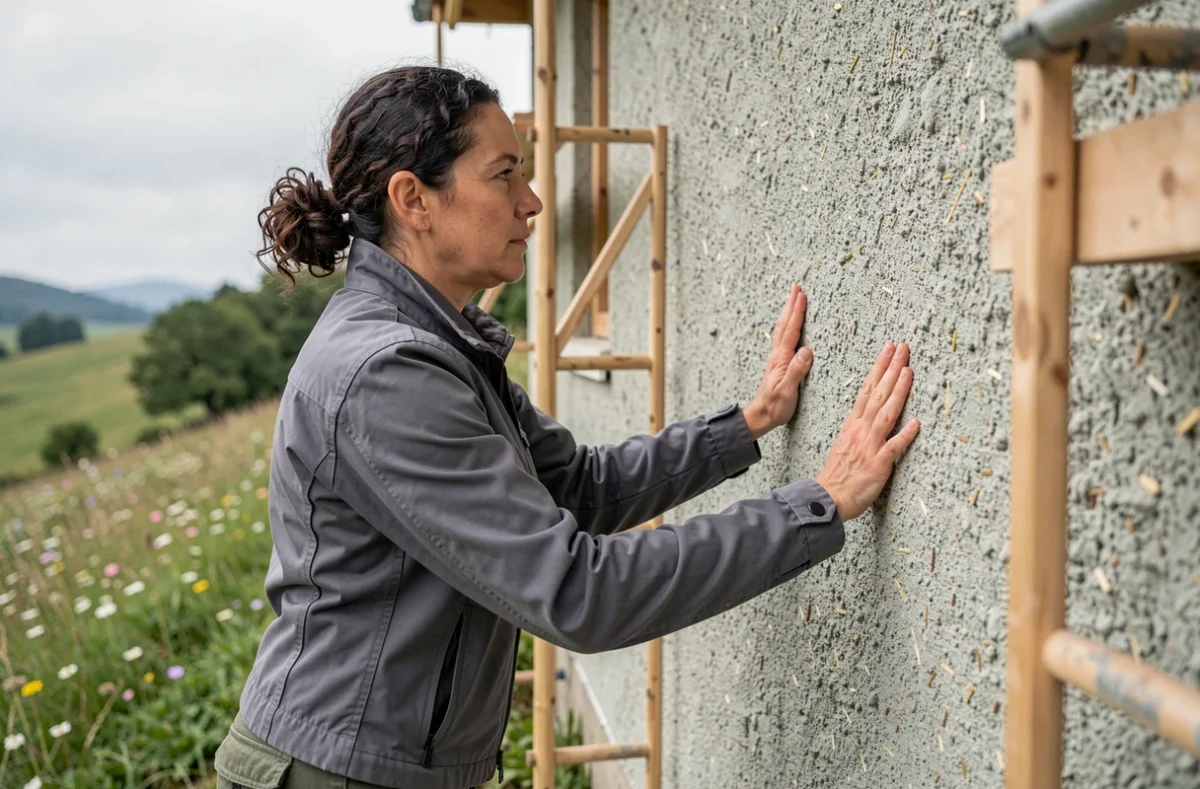
Wood, hemp, straw, cellulose wadding, and cork are mentioned in all articles about eco-construction. What is less often explained is how RE2020 concretely guides the choice between these materials.
The regulation requires a life cycle analysis for all new constructions. Each material is assessed based on its production, transport, implementation, use, and end of life. A locally produced biosourced insulation does not have the same balance as an imported insulation, even if both carry the “ecological” label.
Criteria that truly influence the choice
- The geographical origin of the material and the transport distance to the site, which directly impacts the project’s carbon calculation
- The material’s ability to store biogenic carbon, a parameter valued by RE2020 that favors wood and hemp sectors
- The end-of-life behavior: a recyclable or compostable material reduces the building’s overall footprint over several decades
- Compatibility with summer comfort requirements, a criterion strengthened by the latest regulatory adjustments
Field feedback varies on the actual extra cost of biosourced materials compared to conventional solutions. Some professionals report a significant initial gap, while others find that the gap narrows as local sectors become more structured. The extra cost depends as much on local availability as on the material itself.
Summer comfort and bioclimatic design: the blind spot of sustainable projects
RE2020 introduced a summer comfort indicator, the degree-hours of discomfort. This parameter requires proof that the building will remain livable during heatwaves without massive reliance on air conditioning. After several summers marked by record temperatures in France, this aspect is increasingly influencing design.
An eco-construction project that focuses solely on winter insulation and energy performance misses the point. The building’s orientation, natural ventilation, and the thermal inertia of materials become design levers on par with the thickness of insulation.
Bioclimatic design and local data
The bioclimatic approach involves leveraging the land, climate, and sunlight to reduce energy needs. A south-facing house with appropriate solar protections consumes significantly less than an identical house poorly positioned on its plot.
The open data published by the ministry now allows verification of how projects delivered under RE2020 manage this parameter. One can observe the design choices actually implemented and their measured results, which was not possible just a few months ago.
Budget of an eco-construction: key areas to monitor
The overall cost of a sustainable project is not limited to the price of materials. The design phase represents an often underestimated item: thermal studies, life cycle analysis, coordination between architect and environmental engineering office. These services are made mandatory or nearly mandatory by RE2020.
Energy savings over time offset part of the initial extra cost, but the speed of return on investment varies greatly depending on the project, local climate, and occupant usage. The available data does not allow for setting a universal threshold.
- The RE2020 thermal study and life cycle analysis are non-negotiable expenses for any new project
- The choice of a site suitable for bioclimatic design can reduce climate engineering costs
- Available aids depend on the type of building, location, and selected materials
A well-managed eco-construction project begins with a verification of the applicable regulatory framework at the date of the permit, a choice of materials based on their actual life cycle, and particular attention to summer comfort. Tools now exist to compare actual practices thanks to open data. It remains for project owners to utilize them before signing anything.