Choosing wedding entertainment that leaves a lasting impression goes beyond just a simple list of ideas. The real challenge lies in the alignment between the type of entertainment, the profile of the guests, and the time of day it takes place. A perfect game during the cocktail hour may fall flat after midnight, and vice versa.
Wedding Entertainment: Comparison by Time of Day
Most guides provide lists of entertainment without linking them to a specific time slot. The table below categorizes the most common formats according to three key moments: cocktail hour, dinner, and dance party.
| Moment | Type of Entertainment | Average Duration | Level of Guest Involvement |
|---|---|---|---|
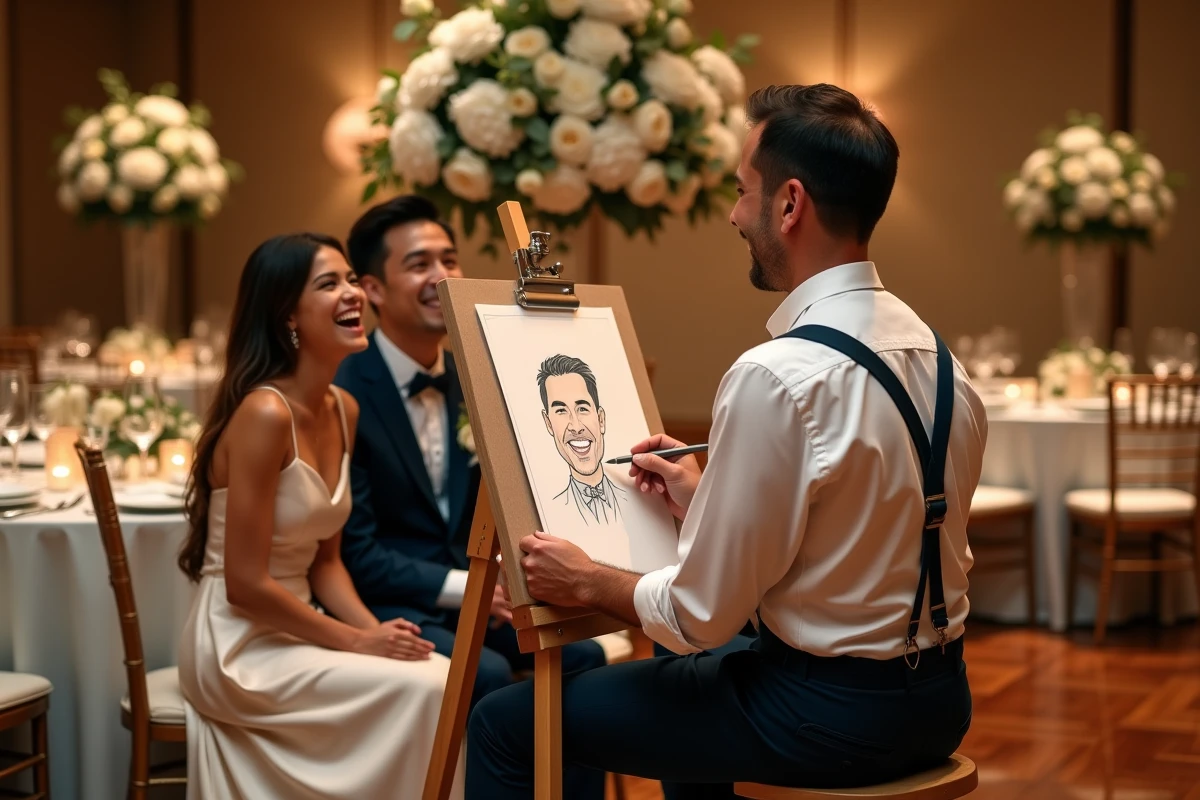
| Cocktail Hour | Photobooth, caricaturist, icebreaker quiz | Entire duration of the cocktail | Low (optional participation) |
| Dinner / Between Courses | “He and She” game, blind test, speeches | 10 to 20 min per segment | Medium (collective attention) |
| Dance Party | Karaoke, flash mob, fire or LED show | Variable | High (physical energy) |
This breakdown helps distribute the effort of attention. Following two high-involvement activities back-to-back can fatigue the audience. Alternating a passive format (show, live artist) with a participatory format (group game, workshop) maintains the rhythm without exhausting the guests.
To browse a catalog structured by type of service, the entertainment on the Mariage Service site allows filtering based on the desired party style.
Participatory Entertainment or Visual Shows: What Works Based on Guest Profile

A wedding with 40 people where everyone knows each other does not require the same formats as a reception with 150 guests from different circles. The number of guests influences the choice of format much more than the budget.
Small Committees and Immersive Entertainment
With a small assembly, activities that require direct interaction work better. A scripted escape game centered around the couple (finding the rings, solving puzzles related to the couple’s story) fosters camaraderie among guests who already know each other.
Creative workshops (cocktail mixing, calligraphy, cupcake decorating) also benefit from this smaller format. Each participant has time and space, making the experience tangible rather than rushed.
Large Receptions and Low-Friction Entertainment
Beyond a hundred guests, formats with optional participation take precedence. The photobooth with themed props, the revamped guestbook (collective canvas, time capsule, wish tree), or the audio guestbook allow everyone to participate at their own pace without disrupting the flow of the evening.
The interactive quiz on smartphones unites a large room without requiring guests to leave their tables. The questions focus on the couple, and the real-time ranking creates a collective excitement that works even among people who have never met.
Regulations on Pyrotechnic Entertainment at Weddings
Fireworks and fire shows appear on all wedding entertainment lists. However, their practical implementation is rarely detailed.
Legal restrictions on pyrotechnic entertainment have tightened in recent years. The use of outdoor fireworks is subject to prefectural orders that vary from one department to another, and some reception venues contractually prohibit any open flame or projectile.
- Check the current prefectural order in the department of the reception venue before booking a pyrotechnic provider
- Request written permission from the owner of the venue mentioning the type of show planned
- Plan for an LED or light drone alternative if local regulations prohibit open flames
- Ensure that the provider has liability insurance covering pyrotechnic shows
Light drone shows are becoming an increasingly common alternative. They offer a comparable visual effect without flame constraints but require a declaration to the prefecture and adherence to authorized flight zones.
Inclusive Entertainment: Adapting Games for Guests with Disabilities
This is an angle missing from most guides on the subject. Adapting entertainment to make it accessible to all guests is as much about consideration for loved ones as it is about the overall success of the celebration.
A blind test works for visually impaired guests but excludes hearing-impaired individuals. An escape game that relies solely on visual clues poses the same problem in reverse. Planning at least one activity that does not depend on sight or hearing (tactile workshop, blind tasting, written quiz projected with simultaneous audio) ensures that no one remains a passive observer by default.
For guests with reduced mobility, games that require quick movement (musical chairs, the 12-month game) should be supplemented with seated alternatives. An accessible photobooth, placed at an appropriate height, often suffices to include everyone without altering the rest of the program.
Number of Activities per Wedding: The Overbooking Trap
Multiplying games and shows gives the impression of guaranteeing the atmosphere of the evening. In practice, three to four well-placed activities throughout the day are more than sufficient. Beyond that, the program becomes a succession of segments that prevents guests from simply chatting, dancing, or enjoying the meal.
The actual time available for activities is shorter than one might think. Between the ceremony, cocktail, dinner, speeches, and first dance, the free slots count in the tens of minutes. Booking a strong activity for the cocktail hour, a collective segment between courses, and a spectacular moment in the evening covers the entire day without saturating the schedule.
The most effective choice remains one that leaves room for spontaneity. The most memorable moments of a wedding often arise in unplanned moments, between activities, when the dance floor fills up on its own.